The scales, materials, and note counts that actually make a difference when you close your eyes and breathe.
In this guide:
- Not all handpans are built for stillness
- 1. D Kurd 9-Note — The one everyone starts with, for good reason
- 2. C# Minor 9-Note — When you need something a little deeper
- 3. D Kurd 12-Note — More range, same soul
- 4. Pygmy 9-Note — For a lighter, more spacious meditation
- 5. Custom Low-Frequency Handpan — The deep dive
- At a glance: how the five compare
- A quick word on materials
- The Best Handpan for Meditation Is the One That Disappears
Not all handpans are built for stillness
Some handpans want you to dance. They’re bright, percussive, almost impatient — the kind of instrument that makes you tap your foot before you even realize you’re doing it.
And then there are the ones that want you to sit down. Close your eyes. Breathe a little slower than you were a minute ago.
If you’re looking for the best handpan for meditation — not for performing, not for busking, not for showing off — the things you should care about are different from what most buying guides tell you. This article is my honest take on the five types of handpans that do meditation best, and why.
I get asked all the time: what’s the best handpan for meditation? It’s probably the most common question I hear — more than about price, more than about tuning, more than about anything. Instead, the honest answer isn’t one model. It’s a handful of options, each fitting a different shape of quiet. That’s what this article is. Not a ranked list. A map.
Quick note before we start: I’m not ranking these. Number 1 isn’t ‘better’ than number 5. They’re different flavors of the same thing — calm. Which one is right for you depends on what kind of quiet you’re after.
1. D Kurd 9-Note (D Minor) — The one everyone starts with, for good reason
I know. I can hear you thinking: ‘D minor again? That’s what every guide says.’
There’s a reason every guide says it. D Kurd is warm without being heavy, emotional without being dramatic, and deeply familiar even if you’ve never heard a handpan before. It’s the scale equivalent of a room you’ve been in before but can’t quite remember when.
For meditation specifically, a 9-note D Kurd gives you enough range to explore without pulling your attention away from your breath. The notes sit in a comfortable mid-range — nothing too high that feels jarring, nothing so low it rumbles you out of your stillness.
This is the handpan I’d recommend to someone who’s never meditated with an instrument before and just wants something that works. It won’t surprise you. It’ll just… be there. Steady. Warm. Consistent.
If you’re completely new to handpans, start with our full beginner’s guide before you decide.
2. C# Minor 9-Note — When you need something a little deeper
If D Kurd is a warm room, C# minor is that same room with the lights dimmed a little further. It’s more introspective. Slightly darker. The kind of sound that doesn’t just accompany your meditation — it pulls you further into it.
I’ve noticed that people who meditate to process difficult emotions — grief, anxiety, the kind of stuff that doesn’t have a name — often gravitate toward C# minor. The scale meets you where you are. Rather than trying to cheer you up, it simply sits with you.
Pair it with nitrided steel for the longest, richest sustain. The notes hang in the air long enough that you can follow one from its birth to its last whisper — which, if you think about it, is kind of the whole point of meditation.
3. D Kurd 12-Note — More range, same soul
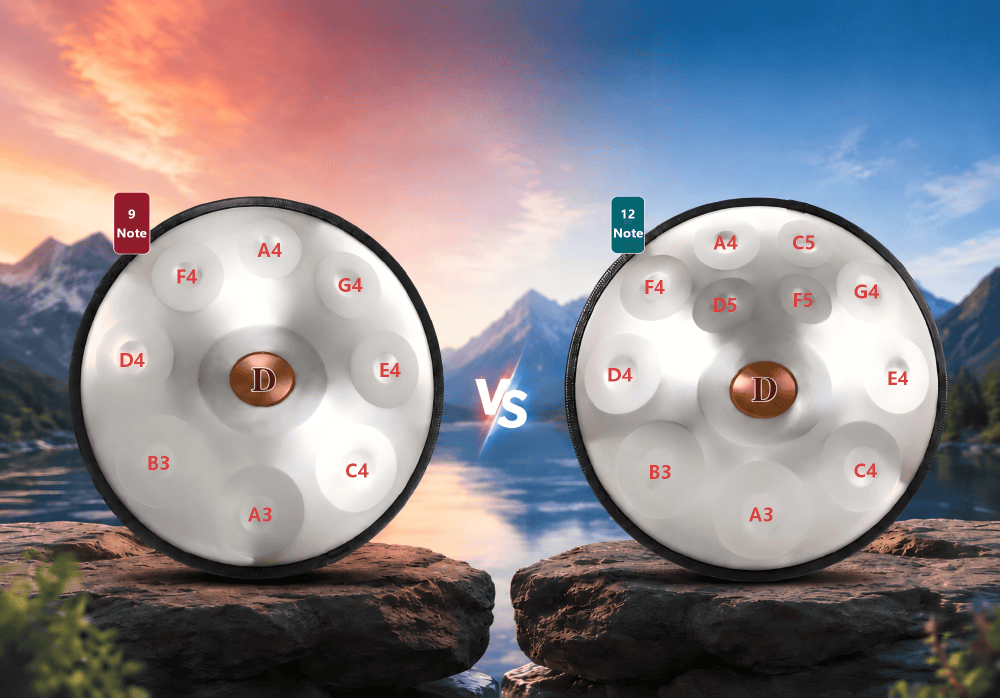
If you’ve been playing for a while and a 9-note feels a little limiting — but you’re not ready to leave D Kurd behind — a 12-note version is the natural next step.
The extra notes (usually a few higher tones and one or two lower ones) give you more melodic options during longer meditation sessions. If you find yourself playing for 30, 40 minutes at a time — which happens more than you’d think once you start — the extra range keeps things from feeling repetitive.
However, there’s a trade-off: 12-note handpans cost more and the tone fields are closer together, which takes a little more precision to play cleanly. Worth it if you’re committed. Probably overkill if you’re just starting out.
4. Pygmy 9-Note — For a lighter, more spacious meditation
Not every meditation has to feel heavy. Some days, you don’t need depth — you need space. Light. The feeling of a window opening.
That’s where Pygmy scales come in. They’re brighter, more open, almost airy. If Kurd is a quiet evening indoors, Pygmy is sitting under a tree on a spring morning. The notes don’t linger as long, but they sparkle more.
I’ve found that people who do morning meditations — the kind where you’re not trying to process anything, just starting the day with intention — often connect with Pygmy more than Kurd. It matches the energy of a fresh start.
However, one thing to know: the sustain on Pygmy scales is often shorter than Kurd. So, if long, blooming notes are central to your meditation practice, this might not be your first choice. But if clarity and lightness are what you’re after — this might surprise you.
5. Custom Low-Frequency Handpan — The deep dive
This one’s different. It’s not a specific scale — it’s a type of tuning where the maker shifts the entire instrument down to a lower register. Think deeper bass, slower vibrations, notes you feel in your chest as much as you hear with your ears.
Low-frequency handpans are less common, usually custom-ordered, and typically more expensive. But for certain kinds of meditation — body scans, deep relaxation, sound baths where the vibrations are the point — they’re unmatched.
I wouldn’t recommend this as your first handpan unless you already know that deep, resonant bass is central to your practice. But if you’ve been meditating with handpans for a while and you’re looking for something that feels different on a physical level — this is worth exploring. Contact us for a custom build.
At a glance: how the five compare
If you skipped here (again, no judgment), here’s the side-by-side:
| Pick | Character | Best for | Vibe |
| D Kurd 9-Note | Warm, familiar, deeply comforting | Anyone new to instrument meditation | A warm room with the lights low |
| C# Minor 9-Note | Introspective, slightly darker | Processing emotions, deep solo practice | The same room, lights dimmed further |
| D Kurd 12-Note | More range, familiar feel | Experienced players, long sessions | The warm room, now with more furniture |
| Pygmy 9-Note | Bright, airy, spacious | Morning meditation, lighter practice | An open window in spring |
| Custom Low-Frequency | Deep, physical, resonant | Body scans, sound baths, experienced meditators | A room you can feel |
A quick word on materials
All five of these work best in nitrided steel. It’s the material that gives you the longest sustain, the richest overtones, and that velvety warmth that makes meditation feel like… meditation. Stainless steel is fine — we wrote a full comparison about it. But if your primary goal is stillness, go nitrided.
Some people find that sustained, low-frequency tones feel especially settling during meditation — exactly the kind of sound nitrided steel produces naturally. I can’t explain the science as well as a researcher could. But honestly, you don’t need a study to tell you what your body already knows when you hear those long, blooming notes.
In most cases, nitrided steel is simply the best handpan for meditation.
The Best Handpan for Meditation Is the One That Disappears
Here’s what I’ve learned after years of sitting with these instruments: the best meditation handpan isn’t the one with the most impressive specs. It’s the one you stop noticing.
When the scale is right, when the sustain is right, when the tuning is right — the instrument disappears. There’s no gap between you and the sound. You’re not thinking ‘wow, listen to that overtone.’ You’re just… there.
That’s what you’re looking for. Not a handpan. A doorway.
If you’re not sure which one fits your practice — we can send you raw demo recordings of different scales and setups. No pressure, no sales pitch. Just the sounds, so you can find the one that disappears for you.