Everything a first-time buyer needs to know — without the overwhelm.
I remember the first time I searched ‘how to buy a handpan.’
I opened about twelve tabs. Every website said something different. One told me D minor was the only scale worth buying. Another said stainless steel was a mistake. A third one — I kid you not — claimed handpans under $2,000 weren’t real instruments. I closed all the tabs and didn’t buy anything for another three months.
I’m writing this guide so you don’t do the same thing. Consider this your handpan beginner guide 2026: it is not a technical manual, and I’m not going to lecture you about harmonics or metallurgy. What I will do is walk you through the five decisions that actually matter when you’re buying your first handpan — and tell you which ones you can safely ignore.

The one thing nobody tells beginners
On the beginner-friendly scales we recommend, the handpan is designed so you can’t play a truly wrong note.
I mean that literally. On those scales, every tone field is tuned to harmonize with the others. You can close your eyes, tap randomly, and it’ll sound intentional. Maybe not beautiful. But never wrong.
This matters because it changes what you should worry about. You don’t need to worry about whether you’re “musical enough.” (You are.) You don’t need to worry about music theory. (You won’t use it.) What you should worry about is a lot simpler: getting an instrument that’s actually in tune, in a scale that feels right to you, at a price that doesn’t make you resent it every time you look at it.
So here’s a question people ask a lot: is the handpan hard to learn?
Honestly — the first five minutes feel awkward. Your hands don’t know where to go. You’ll hit the edge of a tone field by accident and get a dull thud instead of a clear note. But by minute twenty, most people are playing something that sounds like actual music. By day three, you’ll have a melody you look forward to coming back to.
It’s not magic. It’s just a well-designed instrument. But something happens when you play it. I can’t explain it better than that.
Decision #1: What scale should you choose?
For most first-time buyers, the safest answer is D Kurd. Here’s how to think about it.
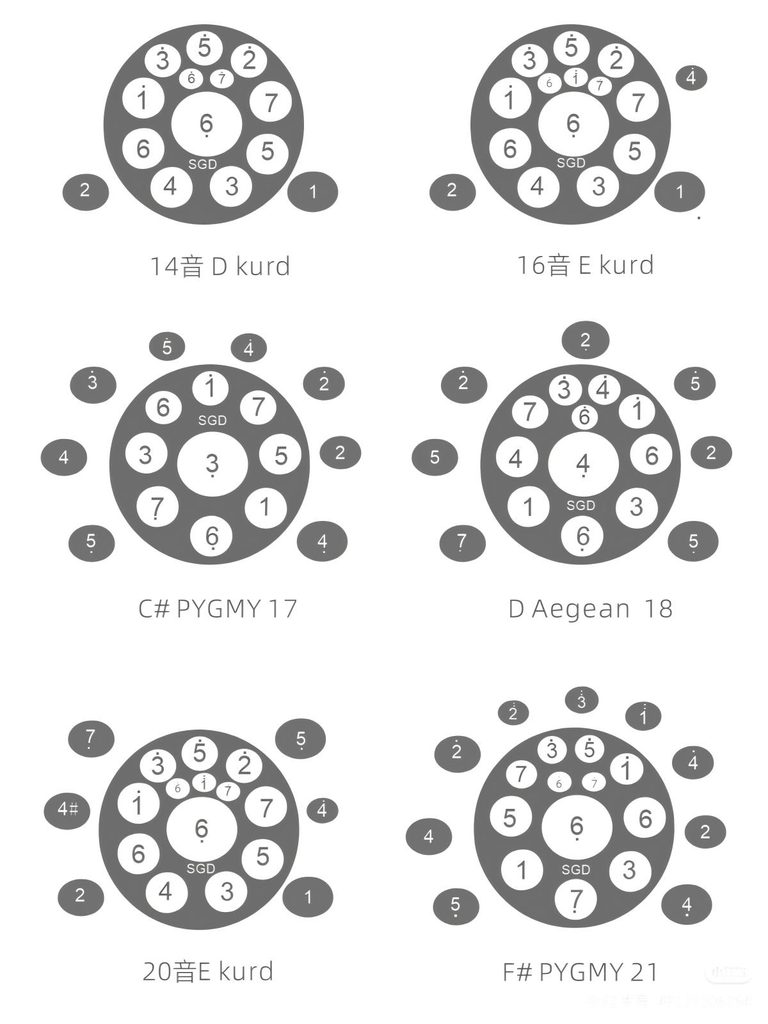
Take a look at the photo above. Six handpans. Six different scales. Different numbers of notes. Different names — Kurd, Pygmy, Aegean.
When I first saw something like this, my reaction was: “…okay, so how am I supposed to choose?”
Here’s the thing. You don’t need to understand all six. You just need to understand what kind of sound you’re after — and there are really only three categories that matter for a beginner.
Category 1: The warm and familiar — Kurd scales
D Kurd. E Kurd. You’ll see these names everywhere, and there’s a reason. Kurd scales — which most people just call “minor” scales — are warm, emotional, and naturally calming. They’re the handpan sound you’ve probably already heard in meditation videos and sound baths.
If you’re looking at the photo: the two on the left and the two on the right are all Kurd scales — just in different keys (D vs E) and with different numbers of notes (14, 16, 20). More notes give you more range. But the emotional texture is the same family.
For a first handpan, D Kurd is the safe, smart choice. It’s the most popular beginner scale for a reason. If you buy a D Kurd and don’t like it… honestly, you probably just don’t like handpans. And that’s fine. But it won’t be the scale’s fault.
Category 2: Brighter and more playful — Pygmy scales
In the middle of the photo, you’ll see two Pygmy handpans: C# Pygmy 17 and F# Pygmy 21. These have a different character entirely — lighter, more spacious, almost playful. If Kurd feels like a quiet autumn evening, Pygmy feels like morning sunlight through a window.
Some people connect with Pygmy instantly. Others find it a bit too bright for relaxation. I’d recommend listening to both before deciding — and if you can’t decide, Kurd is the safer bet.
Category 3: The wildcard — Aegean and beyond
In the photo, there’s a D Aegean 18 — a less common scale with a distinct, almost Mediterranean flavor. It’s beautiful. But it’s specific.
I wouldn’t recommend Aegean (or other less common scales like Hijaz or Annaziska) as a first handpan. Not because they’re bad — they’re not. But because they’re harder to predict. You might love it. You might feel stuck with a sound you didn’t expect. For your first instrument, go with something widely loved for a reason.
Still unsure? We can send you real, unedited demo videos of different scales so you can hear the difference with your own ears. No studio effects. Just the instrument, played plainly.
Decision #2: Nitrided steel or stainless steel?
For most beginners who want relaxation, nitrided steel is the better default. Here’s the short version:
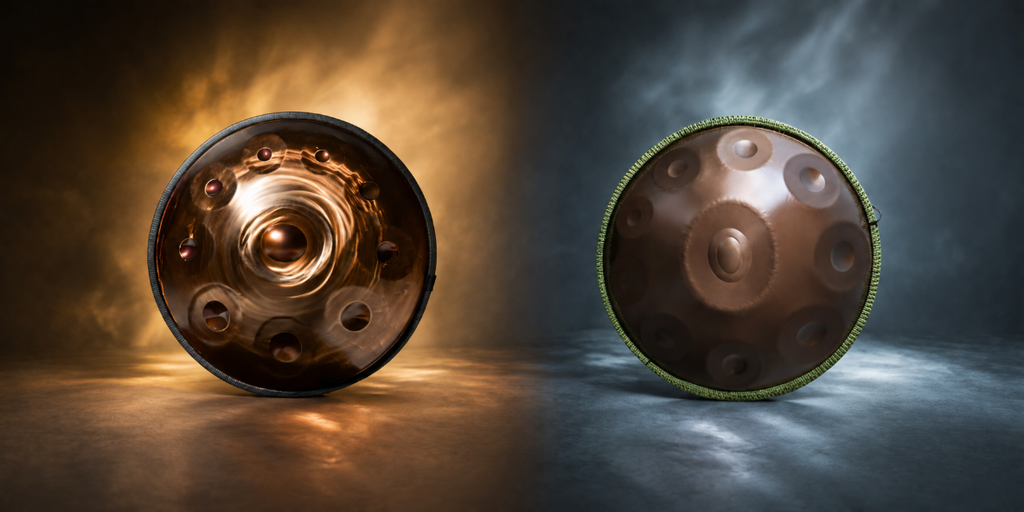
Nitrided steel: warmer tone, longer sustain, richer overtones. Slightly more care required — oil it every couple of weeks. Best for meditation and sound healing.
Stainless steel: brighter, more percussive, more resistant to humidity. Less maintenance. Better if you live somewhere humid or plan to play outside a lot.
For most beginners looking for relaxation and stress relief, I’d point you toward nitrided steel. The warmth just… does something. But if you’re in a coastal city or you hate the idea of maintenance, stainless is a perfectly good choice. You’re not making a mistake either way.
If you choose nitrided steel, follow our Care Guide to keep it in tune.
Decision #3: How many notes? (And what about size?)
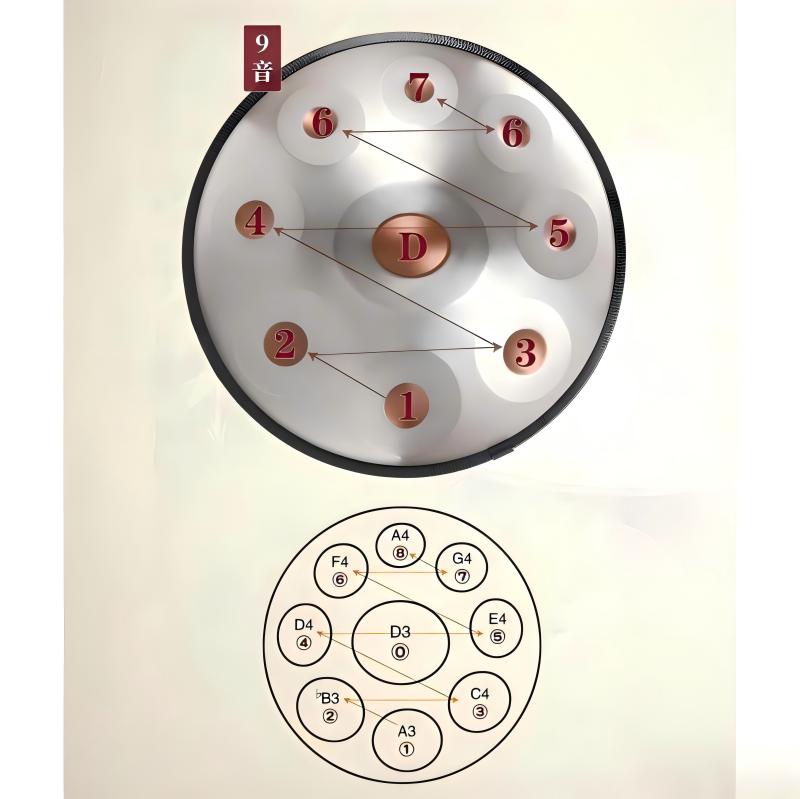
9 notes. That’s the answer for almost every beginner.
A 9-note handpan gives you 8 tone fields around the center ding — enough range to play real melodies and explore different rhythms, without being overwhelming. It’s the Goldilocks number.
12-note handpans exist. They’re impressive. But honestly, as a beginner, you’ll spend a lot of those extra notes just… not using them. And they add cost. A well-tuned 9-note handpan played with intention will sound better than a 12-note one you’re still trying to navigate.
As for size — 53 cm (about 21 inches) is the standard, and that’s what I’d recommend. It sits comfortably on your lap. The notes have enough space between them that you won’t accidentally hit the wrong one. If you have especially small hands or plan to travel with it, 43 cm (17 inches) exists. But most people are happiest with the standard size.
Decision #4: What should you actually pay?
A quality handpan starts around $1,200. Let’s talk numbers — real ones.
A quality handpan from a skilled maker — the kind that stays in tune, sustains beautifully, and doesn’t make you wince — starts around $1,200 and goes up from there. Custom scales, more notes, special finishes: these add cost. A fully custom instrument from a well-known maker might run $2,500 to $4,000.
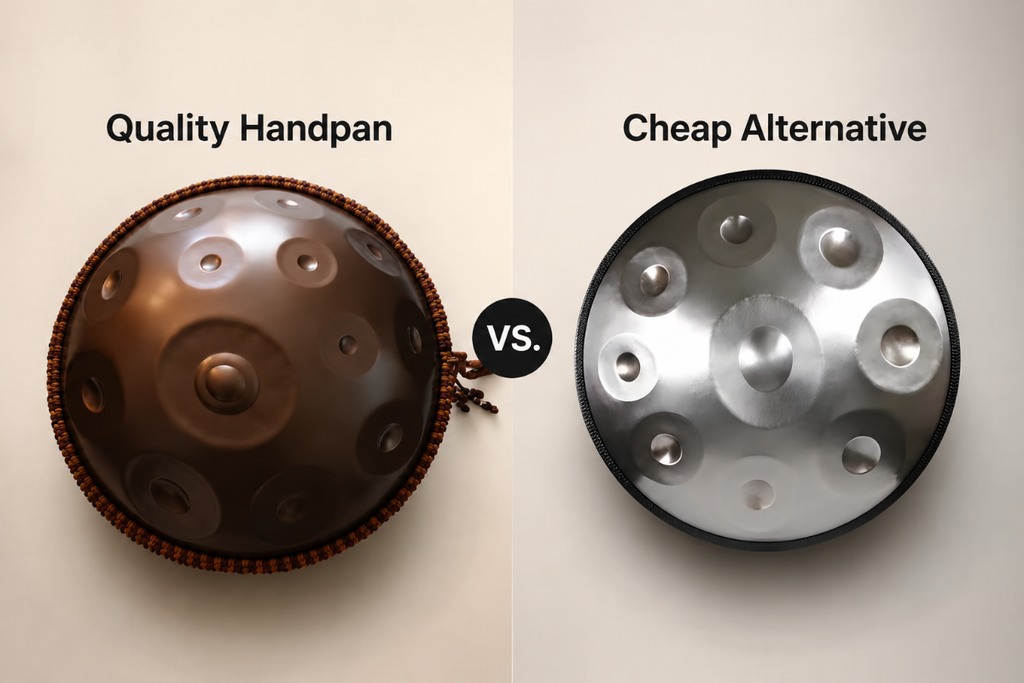
You’ll see handpans for $300 or $400 online. I’m going to be honest with you: these are almost never worth it.
A $300 handpan isn’t a bargain. It’s a different product entirely — usually machine-stamped, poorly tuned, with weak sustain and notes that drift out of tune within weeks. It’ll look similar in photos. When you play it, the difference isn’t subtle. It’s the difference between an instrument and a decorative bowl.
If $1,200+ feels like a stretch — I get it. It is a lot of money. But here’s the thing: a bad handpan doesn’t save you money. It just guarantees you’ll either give up or buy a second one. Either way, the $300 ends up costing more.
Decision #5: How do you know it’s good before it arrives?
Ask for a raw video, ask who made it, and ask about the tuning. Those three questions cover most of the risk.
You can’t hold it. You can’t play it. You’re about to send someone a significant amount of money based on photos and a promise. This was the part that stressed me out the most. Here’s what actually helped:
Ask for a raw video. Not a produced demo. Not a recording with reverb added. Just someone playing the instrument — your instrument — in a normal room, with a phone. You should be able to hear each note clearly, sustain without wobbling, and a general sense that the instrument “rings” rather than “thuds.”
Ask who made it. A real handpan comes from a person — a craftsman with a name, a workshop, and ideally some reputation in the community. If the seller can’t or won’t tell you who made the instrument, that’s a red flag.
Ask about the tuning. Every handpan drifts slightly over time. A well-tuned handpan should hold its tuning for years with basic care. Ask when it was last checked. If the answer is vague, be careful.
And if you’re buying through us — we do this work for you. Every handpan we handle gets personally played, inspected, and verified before it ships. We’re the annoying friends who check everything so you don’t have to.
Your Handpan Beginner Guide 2026: A Quick Summary
If you skipped here (no judgment), here’s the condensed version:
- Scale: D Kurd (D minor). The most popular beginner scale for a reason.
- Material: Nitrided steel. Warmer, longer sustain. Better for relaxation.
- Notes: 9 notes. Enough range without overwhelm.
- Size: 53 cm. Standard. Comfortable. Tried and tested.
- Price: $1,200 and up for quality. The $300 ones aren’t the same product.
- Trust: Ask for raw video. Ask who made it. Ask about tuning. If answers are clear and confident, you’re probably in good hands.
Handpan Beginner Guide 2026: Common Questions
What is the best handpan scale for a beginner?
D Kurd (D minor). It is the most popular beginner scale because it is warm, forgiving, and naturally calming.
How much should a quality first handpan cost?
Expect to spend about $1,200 or more for a hand-hammered, well-tuned instrument from a skilled maker.
Is nitrided or stainless steel better for relaxation?
Nitrided steel is usually the better choice for relaxation — warmer tone and longer sustain. Choose stainless steel if you live somewhere humid or prefer less maintenance.
How can I tell if a handpan is good before buying?
Ask for a raw video, ask who made it, and ask when it was last tuned. Clear, confident answers are a good sign.
One last thing
The handpan I eventually bought — after three months of overthinking — wasn’t the one with the best specs. It wasn’t the most expensive. It was the one whose demo video made me feel something.
Numbers and recommendations are useful. But at some point, you just have to listen and trust your gut. The right handpan isn’t the one with the most features. It’s the one that makes you want to sit down and play.
And if you’re still unsure — we’re here. Send us a message. We’ll send you real videos. No pressure, no rush. Just the honest guidance we wish we’d had when we started.