Every handpan we feature is personally played and evaluated by our team. We check tuning accuracy, resonance quality, and most importantly — how it makes you feel. Because a handpan that doesn’t calm us, won’t calm you.
Three paths, one destination — inner peace through sound. Choose the one that speaks to you.
Handpans with deep, grounding tones in D Minor and C# Minor scales. Slow-decay sustain that holds you in stillness. Ideal for daily meditation, yoga, and unwinding after a long day.
Forgiving, intuitive instruments that sound beautiful no matter where you touch. Start with a 9-note D Minor — the most accessible scale. No music theory or prior experience needed.
For experienced players and sound therapy practitioners. 10+ note handpans with exceptional overtone clarity and extended sustain — instruments that reward a refined ear.
Most handpans are tuned to 440Hz — the global industrial standard. We exclusively source 432Hz. Here is why that matters for your practice.
| Tuning | What It Is | How It Feels | Market Share | Best For |
|---|---|---|---|---|
| 440Hz (ISO 16 Standard) |
The global standard pitch since 1955. Every piano, guitar, and orchestra uses it. Most handpans are tuned to 440Hz by default. | Familiar and sharp. Notes feel precise and defined. Designed for ensemble playing where instruments must match. For solo meditation, some find it slightly “edgy” over extended listening. | ~85 – 90% of handpans | Playing with other instruments, recording with backing tracks, general use |
| 432Hz (Verdi’s A / Natural Tuning) |
Slightly lower than 440Hz — about 32 cents flat. Historically favored by Verdi and used in some classical traditions. Gaining popularity in sound healing and meditation communities worldwide. | Warmer, rounder, and subjectively more “relaxed.” The slightly lower pitch creates a sense of spaciousness. Many meditators report feeling less auditory fatigue during long sessions — the notes seem to breathe rather than assert. | ~10 – 15% of handpans | Meditation, sound baths, solo practice, stress relief, anyone sensitive to high frequencies |
We do not claim 432Hz has magical properties. What we observe — and what thousands of players report — is that the slightly lower pitch feels physically more comfortable during extended listening. From an acoustics standpoint, 432Hz aligns more closely with the natural overtone series produced by a handpan’s steel body. At minimum, it is worth experiencing for yourself.
Two materials dominate the handpan world. Each has a distinct personality — and the choice affects not just sound, but how the instrument feels in your hands and how it ages with you.
| Material | Sound Character | How It Feels | Durability & Care | Best For |
|---|---|---|---|---|
| Nitrided Steel (Heat-treated carbon steel) |
Warm, organic, earthy. Rich bass with rounded overtones. | Like a wooden cabin fireplace — enveloping and grounding. Notes blend together smoothly, creating a sense of being held. The sound has body and depth that you can feel through your lap. | Good rust resistance after treatment. Needs periodic oiling — included in your Healing Kit. Develops a subtle patina over years. Many players consider this part of the instrument’s character. | Meditation, sound baths, emotional grounding, those who value warmth and depth over clinical precision |
| Stainless Steel (Chromium-alloy steel) |
Bright, clear, crystalline. Longer sustain with more note separation. | Like morning sunlight through a clean window — crisp, articulate, and uplifting. Each note stands distinctly on its own. The clarity can feel more energizing than grounding. | Excellent natural rust resistance. Minimal maintenance needed. Retains its original appearance for years — ideal for humid climates or outdoor use. | Active playing, uplifting moods, humid environments, those who prefer clarity and minimal maintenance |
| Raw Steel (Untreated carbon steel) |
Soft, muted, intimate. Shorter sustain, very organic decay. | Like an old acoustic guitar — unpolished and deeply personal. The sound is quieter, almost whispering. There is a raw honesty to it. Appeals to purists who value character over perfection. | Requires regular oiling and careful storage. Will naturally darken and develop a unique patina. Not recommended for humid climates without diligent care. Rare in modern production. | Purists, collectors, those who enjoy the ritual of instrument care, very intimate solo practice |
The majority of handpans we curate are nitrided steel — it is the preferred choice for meditation and sound healing due to its warm, grounding character. Stainless steel is available upon request for those in humid climates or who prefer a brighter voice. Material characteristics described above reflect widely reported player experiences across the handpan community.
Each scale carries a different emotional signature. Here is how the most popular ones compare.
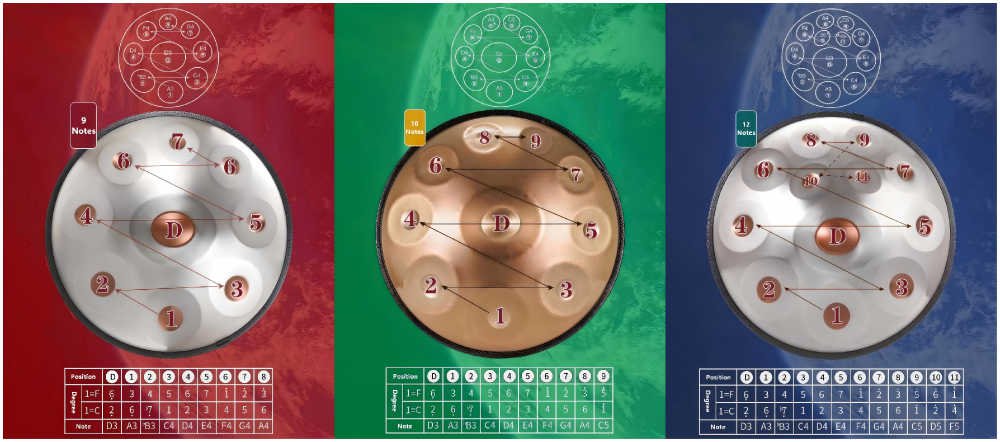
| Scale | Emotional Character | How It Feels | Best For |
|---|---|---|---|
| D Minor (D Kurd) |
Melancholic yet warm — the most balanced scale | Like a gentle rain on a quiet afternoon. Notes flow naturally into each other, creating a safe emotional container. The scale that made handpan famous. | Daily meditation, stress relief, beginners, general relaxation |
| C# Minor | Deep, introspective, mysterious | The lowest-pitched common scale. Each note lands with weight and presence. Creates an atmosphere of sacred stillness — ideal for closing your eyes and going inward. | Deep meditation, sound baths, extended solo practice, inner work |
| Kurd (Various keys) |
Warm, narrative, grounding | Named after Kurdish folk music. Has a storytelling quality — melodies feel like they are going somewhere. Rooted and earthy without being heavy. | Emotional release, reflective journaling, gentle movement practices |
| Annaziska (Pentatonic) |
Light, playful, effortlessly beautiful | Based on a five-note pentatonic structure. Almost impossible to create dissonance — every combination sounds pleasant. The most forgiving scale for absolute beginners. | First-time players, creative play, uplifting mood, family settings |
| Aeolian (Natural Minor) |
Balanced, versatile, harmonious | The natural minor scale in its purest form. Not as dark as C# Minor, not as bright as major scales. A versatile middle ground that adapts to your mood. | Versatile daily use, both active playing and passive listening, mixed practice |
| Hijaz | Exotic, evocative, transporting | A Middle Eastern scale with a distinctive interval that creates immediate atmosphere. Transports the listener — like stepping into a different world. Less intuitive for Western ears, but deeply rewarding. | Spiritual exploration, world music appreciation, unique sonic journeys |
This table reflects widely recognized characteristics shared across the handpan community. Every instrument has its own voice — these are guides, not rules.
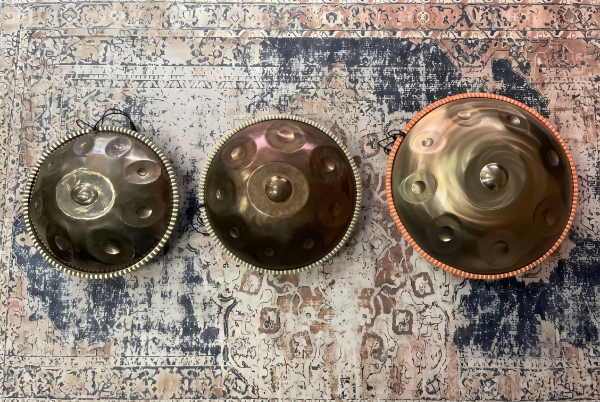
More notes means more possibilities — but also more decisions. For meditation, sometimes less is more.
| Note Count | Typical Diameter | Experience | Best For |
|---|---|---|---|
| 8 Notes | 50 – 53cm | The minimalist’s choice. One full octave plus one extra note. Every tone field has generous space, making it forgiving for uncertain fingers. With fewer options, your mind wanders less — you sink into repetition and presence. Ideal for mantra-like playing where a single pattern becomes a meditation. | Pure meditation practice, beginners who want simplicity, those who value focus over variety, mantra and repetitive pattern work |
| 9 Notes | 53 – 56cm | The industry standard for a reason: enough range to stay interesting for years, not so much that it overwhelms. One full octave plus two expression notes. This is the configuration we recommend to most first-time buyers — it grows with you without ever feeling bloated. | Balanced daily practice, most beginners, those who want one handpan to serve all purposes, the sweet spot for most people |
| 10+ Notes | 56cm+ | Extended range that opens up more melodic possibilities. Tone fields are more tightly packed, requiring slightly more precision. The larger diameter means richer bass, but also a heavier instrument. More notes can be inspiring — or distracting, depending on your intention. | Experienced players, sound therapists who need extended range, those who enjoy melodic exploration, collectors |
If you are here for meditation and stress relief, we suggest starting with 8 or 9 notes. Fewer choices mean less thinking. Less thinking means deeper stillness. You can always explore more notes later — but you cannot remove complexity from an instrument that has too much of it.
Handpans come in three common diameters. Each affects portability, volume, and how the instrument feels under your hands.
| Diameter | Typical Notes | Weight | Practical Experience | Best For |
|---|---|---|---|---|
| 43 – 46cm Travel / Compact |
7 – 8 notes | 3 – 4 kg | Light and portable — easily fits in a backpack or carry-on. Smaller playing surface means notes are closer together. Volume and sustain are more intimate. Feels like holding a conversation rather than addressing a room. | Travel, outdoor meditation, smaller hands, casual daily play, portability first |
| 50 – 53cm Standard / Medium |
8 – 9 notes | 4.5 – 6 kg | The sweet spot for most players. Comfortable lap placement with enough resonance to fill a living room. Notes are well-spaced for relaxed playing. The most commonly produced size — widest selection available. | Home practice, balanced portability and sound, most beginners, general use |
| 55 – 57cm Full / Large |
9 – 10+ notes | 6 – 8 kg | Richer, deeper resonance with noticeably longer sustain. The larger cavity produces fuller bass tones that you can feel through your body. Requires more lap space and a bit more reach — but rewards with a more immersive physical experience. | Deep meditation, sound healing sessions, seated floor playing, maximum resonance |
Size affects resonance, portability, and playing comfort. There is no "best" size — only the right size for your body, your space, and your practice.
Tell us what you are looking for. We will send you real, unedited demo videos of handpans that match your needs — so you can hear the difference yourself before making any decision.
100% Free Consultation · No Pressure · Real Demo Videos